
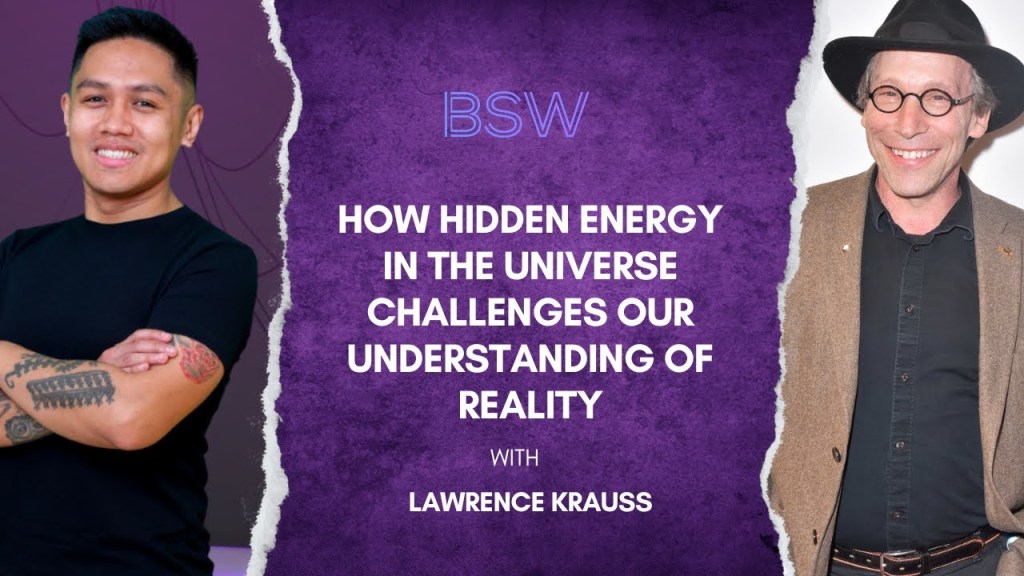
🌌 The universe is far more mysterious than we can imagine. This week on “Business Story of the Week,” hosted by Joshua Lori, we dive into one of the most puzzling mysteries in science: dark energy. Joining Joshua is renowned scientist Lawrence Krauss, whose expertise shines through in this captivating conversation.
We all know about the visible matter that makes up stars, planets, and galaxies, but did you know that the majority of the universe’s energy is actually hidden? Yes, most of the energy resides in what seems to be empty space! 🤯 How is that possible?
Dark Energy: The Universe’s Invisible Puzzle
At the heart of this episode is the discussion about dark energy, which remains one of the biggest mysteries in modern physics. As Lawrence Krauss explains, “Most of the energy in the universe resides in empty space,” a concept that still baffles scientists. This energy, invisible to the naked eye, is causing the universe to expand at an accelerating rate. Why is this happening? Well, we don’t know… yet!
🔬 According to Krauss, the leading theory is Einstein’s cosmological constant—a mathematical addition Einstein made to his theory of general relativity. At the time, he didn’t even realize the groundbreaking implications of this concept! Fast forward to today, and we now suspect that the energy of empty space is not zero, which challenges everything we know about the universe.
The Next Big Breakthrough?
Joshua asks a fascinating question: What’s your favorite theory about dark energy? Krauss answers candidly, explaining that while we have several ideas, there’s no definitive answer yet. One of the more intriguing possibilities is that the universe’s hidden energy could eventually be released, which, in some scenarios, might even result in the universe as we know it disappearing. 😱 Imagine that—everything gone in a flash!
But don’t worry, this apocalyptic event is not likely to happen anytime soon. In fact, it might never happen at all. However, solving the mystery of dark energy could earn someone the next Nobel Prize. Krauss believes this challenge won’t be easily overcome, as it may require a revolutionary idea or even a new way of thinking about physics altogether. 🏆
The Expanding Universe: What Does It Mean for Us?
One of the key takeaways from this episode is the understanding that the universe is expanding, and the rate of this expansion is increasing. This concept is mind-boggling because it contradicts what we would expect. According to Krauss, in a few trillion years, all galaxies will have moved so far away that future civilizations won’t be able to see them. The universe will appear dark and empty, and the remnants of the cosmos will be almost unrecognizable. 🌠
It’s both humbling and awe-inspiring to think about the distant future of our universe. Our ability to even talk about this, thanks to science, is incredible in itself. Krauss reminds us that we’re living in a time when we can make educated guesses about the future of the universe, which is remarkable given how much we still don’t know.
The War on Science
Lawrence Krauss also discusses his upcoming book, The War on Science, which sheds light on a growing problem: the attack on free speech and open inquiry in scientific research. This “war” is especially evident in Western universities, where professors and researchers are sometimes hesitant to share their findings for fear of offending others or being penalized for their views.
It’s a troubling reality that threatens the progress of science and education. Krauss calls for open discourse and urges scientists and educators to continue speaking out, even when it’s uncomfortable. 💬 The book, scheduled for release next year, will feature essays from renowned figures like Richard Dawkins and Steve Pinker, exploring the various facets of this war on knowledge.
🎓 As Krauss eloquently puts it: If we can’t ask questions and debate ideas, we halt the progress of science. This message is more critical now than ever before.


 MonsterKong.marketing
Leave a reply to Justin Cancel reply